
PLCs play a critical role in controlling industrial processes, managing equipment behavior, and ensuring systems operate safely and reliably. IAS develops and modifies PLC programs that provide consistent control logic, predictable responses, and clear fault handling to keep production running efficiently under both normal and abnormal conditions. Before software development begins, IAS typically creates a functional specification that defines how the system is intended to operate, how it behaves across different modes, and how it responds during fault conditions, ensuring all stakeholders share a clear understanding of system behavior.
IAS programs PLCs for systems ranging from highly automated processes requiring minimal operator interaction to complex operations with frequent state changes and fault handling requirements. Our applications are designed for long-term adaptability, supporting future expansion, equipment changes, and evolving operational needs. All PLC software is thoroughly tested offline prior to deployment to reduce startup risk and support smooth commissioning.
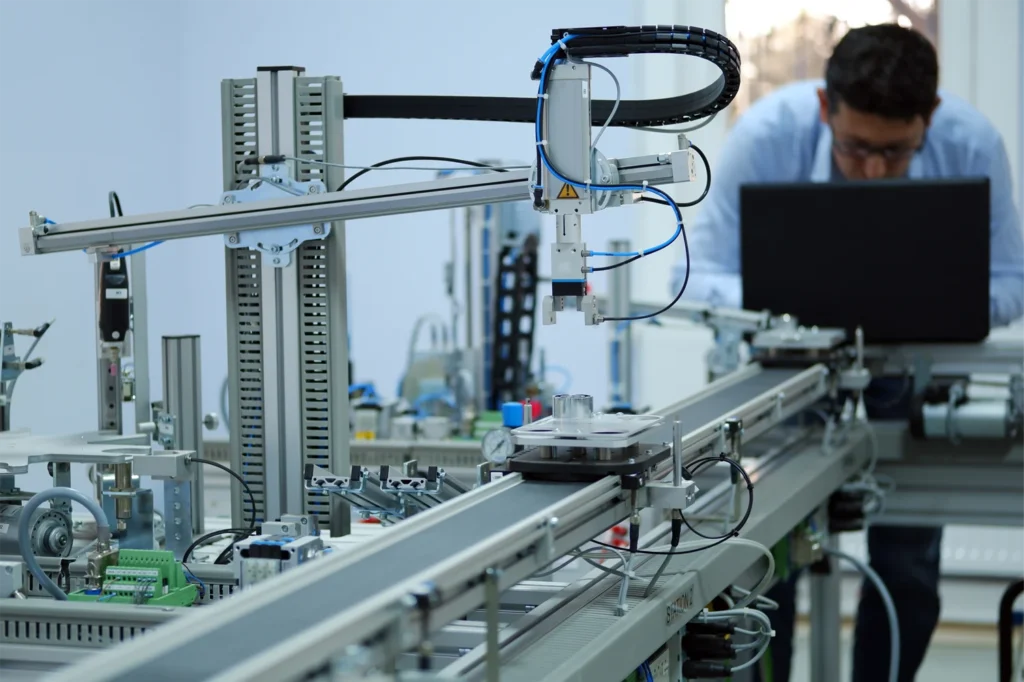

IAS primarily programs using the Allen‑Bradley PLC platforms. We support ControlLogix, CompactLogix, MicroLogix, and legacy PLC hardware, allowing us to work within new or existing infrastructure while delivering reliable, maintainable control solutions.
IAS primarily programs using the Allen-Bradley PLC platforms, supporting ControlLogix, ComactLogix, MicroLogix, and legacy PLC-5 and SLC hardware. Proficiency in current and legacy platforms allows IAS to work within new and existing infrastructure to deliver reliable and maintainable control solutions.
IAS also regularly integrates PLC systems with non-Allen-Bradley equipment, including inspection cameras, vision systems, checkweighers and OEM “black box” equipment. Depending on the device and project requirements, we typically interface using Ethernet, Modbus TCP or Modbus RTU. When integrating with Siemens-based systems, IAS commonly uses hardwired signal exchange.
IAS regularly integrates non-Allen-Bradley equipment using Ethernet I/P, Modbus TCP, or Modbus RTU communications. This may include vision systems, checkweighers, and other OEM “black box” equipment. When integrating with Siemens based processors, IAS commonly uses hardwired signal exchange.
In each case, IAS develops the required communication structure, data mapping and control logic to ensure reliable data flow and coordinated operation across the production environment.
